
The two-year rule is real, but it attaches to the kind of income you earn rather than to you. Here is which version applies to a new job, variable pay, self-employment and newcomers to Canada.
Almost everyone shopping for a mortgage has heard that lenders want two years of history. It is one of the most repeated and most misunderstood ideas in Canadian lending. The two-year expectation is real, but it attaches to the kind of income you earn, not to you as a borrower. Which version applies to you usually changes the answer.
If you have just changed jobs
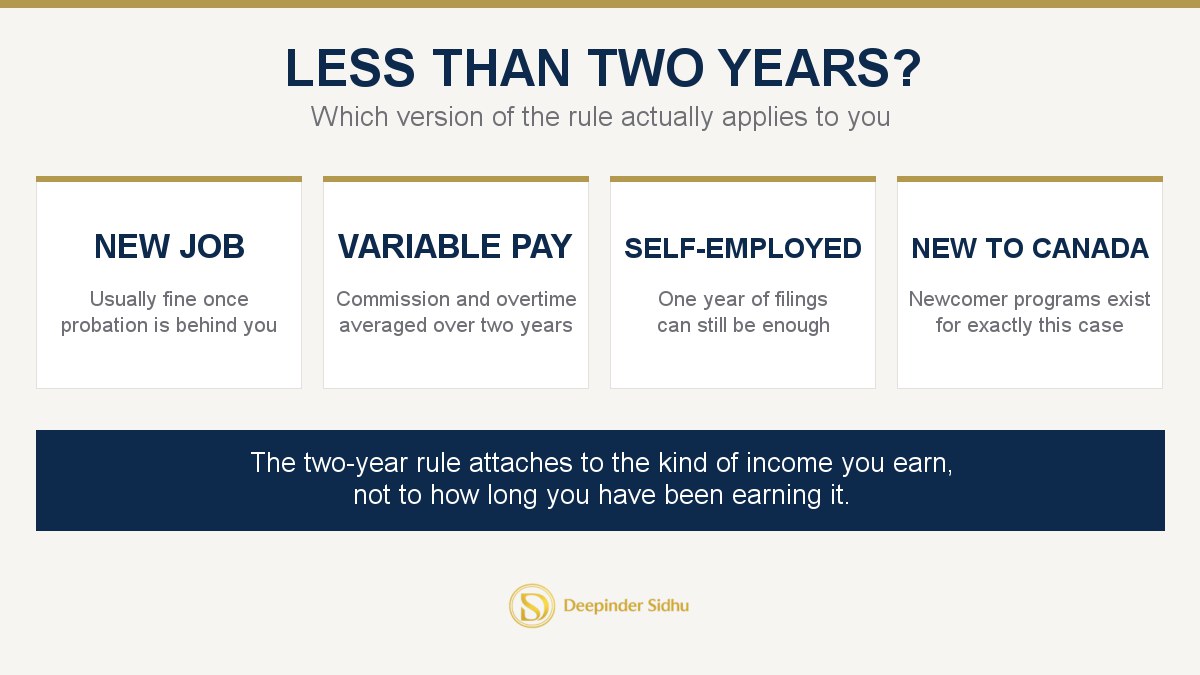
Salaried, permanent, full-time work is the straightforward case. Moving to a new employer in the same line of work rarely blocks an approval on its own, and many lenders are comfortable with a signed offer and a pay stub or two. Probation is the sharper question, not your overall tenure. Lenders also re-verify employment shortly before funding, so changing roles midway through a purchase causes far more trouble than simply being new.
If your pay varies
Here the two-year rule is genuine. Commission, bonuses, overtime, tips and part-time hours are normally averaged across two years rather than taken at your current pace. A strong recent year lifts that average without replacing it, which is why a pre-approval built on your best twelve months can quietly mislead you.
If you are self-employed
Under two years of filings the field narrows, but it does not close. Some lenders will work from a single year of returns, and alternative lenders will look at business bank statements instead of a tax return alone. Our self-employed approval guide sets out the documents in full, and the self-employed mortgage page explains how the income is read.
If you are new to Canada
Newcomer programs exist precisely for people with no Canadian history. Permanent residents can reach insured financing at the standard minimum down payment, and those on a valid work permit have routes too, generally with more money down and a few months of Canadian employment behind them.
The one move to avoid is applying everywhere at once. Every application leaves an inquiry, and a run of declines makes the next lender cautious. Have the file looked at first, then send it to the lender whose rules actually fit it.